
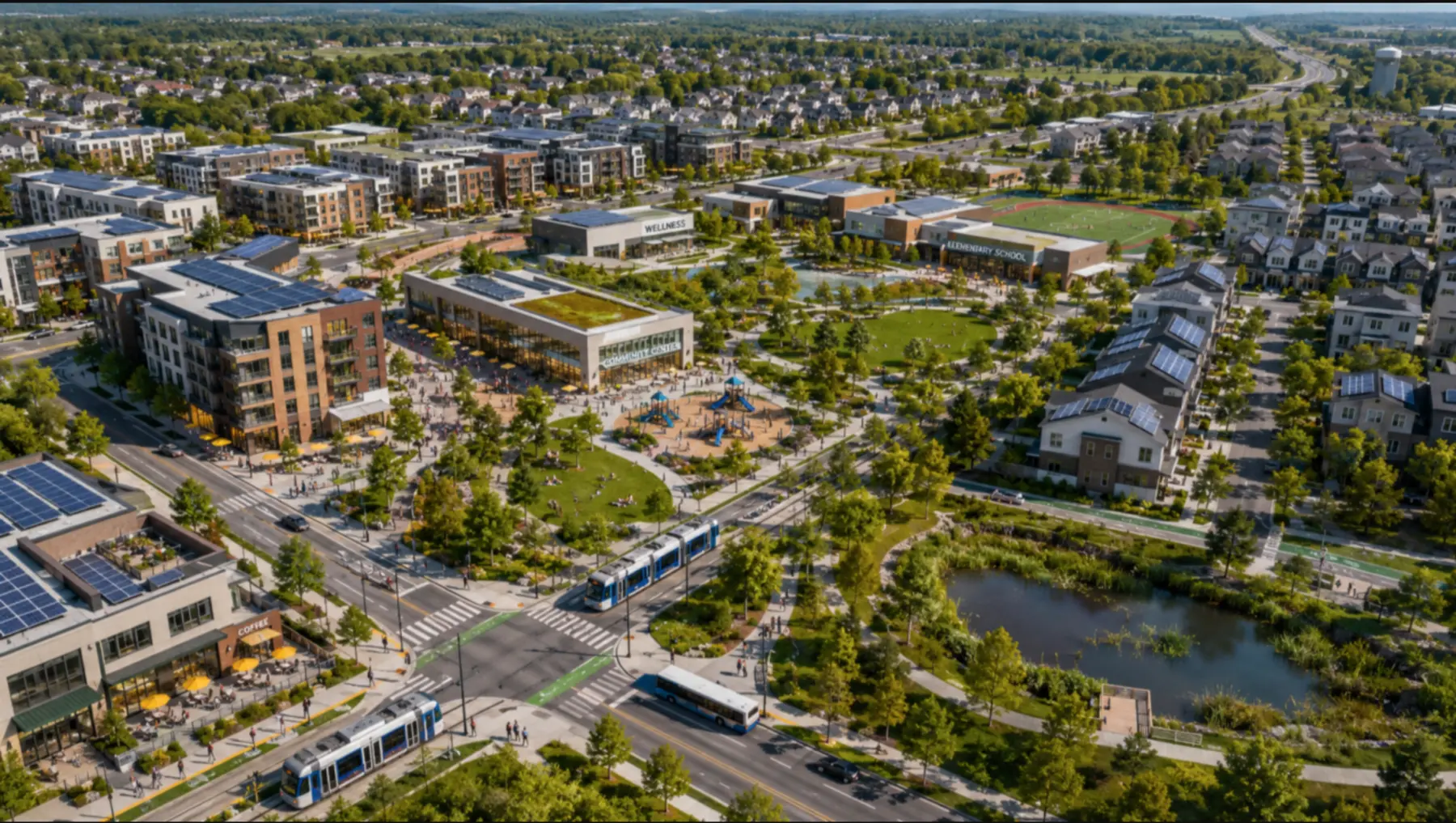
We often describe today’s challenge as a housing crisis.
And in one sense, that is true. Across Canada, the United States, and many other parts of the world, we need more homes. We need more rental units, more ownership options, more attainable housing, more supportive housing, more family-sized homes, more housing near transit, and more housing in places where people can realistically build a life.
Supply matters. It matters deeply.
But I believe we are dealing with something larger than a housing problem alone.
We are facing a community-delivery problem.
That distinction matters, because the way we define the problem determines the way we solve it. If we define the challenge only as a shortage of units, then the solution becomes relatively narrow: build more units, faster. That is necessary, but it is not sufficient.
The deeper question is this:
Are we building enough housing, or are we building the right kinds of homes, in the right kinds of places, within the right kinds of communities?
Because those are not the same thing.
A housing unit is not just a product. It is part of a larger ecosystem. It sits within a street, a neighbourhood, a mobility network, an economic context, a social fabric, and a governance structure. The quality of that ecosystem determines whether the housing becomes a place where people merely reside, or a place where they can genuinely live.
Livability is part of affordability
That is why some housing struggles to attract buyers or tenants while other housing is in constant demand. Price is obviously a major factor, but it is not the only one.
People are also making choices based on livability.
They are asking, even if not always consciously: Can I get to work? Can my children get to school? Can my parents age nearby? Can I walk to daily needs? Is there access to healthcare, recreation, commerce, culture, and nature? Is the neighbourhood safe, beautiful, and dignified? Does the unit itself work for real life? Is there light, storage, flexibility, privacy, and a sense of belonging?
These questions are not secondary. They are central.
Affordability and quality are often treated as opposing forces, as though good design is a luxury that must be sacrificed in order to reduce cost. I think that is a false choice.
Poorly designed communities are expensive in ways we often fail to measure.
They create transportation burdens. They isolate seniors. They make childcare harder. They reduce social connection. They increase infrastructure inefficiencies. They limit access to opportunity. They contribute to poor health outcomes. They force families to spend more time, money, and energy navigating daily life. In that sense, affordability is not only about the monthly rent or mortgage payment. It is also about the total cost of living.
A home that is cheaper on paper but disconnected from employment, transit, education, healthcare, and community support may not actually be affordable in practice. Conversely, a well-located, well-designed home within a complete community can create value far beyond the walls of the unit itself.
Urban design is infrastructure
This is where urban design becomes essential.
Not as decoration. Not as an afterthought. Not as something to be value-engineered out of the process once the pro forma gets tight.
Urban design is part of the infrastructure of affordability.
It shapes whether communities function well over time. It influences how people move, gather, interact, work, shop, age, raise families, and participate in civic life. It determines whether density feels oppressive or humane, whether mixed-use development feels chaotic or vibrant, whether streets become corridors for cars or places for people. Density alone does not create community. Buildings alone do not create belonging. Infrastructure alone does not create quality of life.
The future requires a more integrated model.
We need a new convergence of design, development, infrastructure, technology, sustainability, finance, and governance—led by people and organizations capable of seeing the whole system at once.
That means architects, planners, developers, municipalities, engineers, builders, investors, community leaders, technology providers, and policymakers can no longer operate in isolated lanes. The challenges are too interconnected. The stakes are too high.
Housing delivery must become community delivery
A complete community is not simply a collection of buildings. It is an environment that supports the full arc of human life.
It includes access to education, healthcare, employment, commerce, mobility, parks, recreation, culture, and social infrastructure. It includes housing for different ages, incomes, household types, and stages of life. It includes transportation redundancy, so people are not dependent on only one way of moving through the city. It includes walkability, cycling, transit, and thoughtful connections to regional networks. It includes public spaces that invite interaction rather than merely fill leftover land. It includes governance models that give residents a sense of ownership, voice, and responsibility.
It also includes sustainability in the fullest sense.
Not only lower-carbon buildings, though those are important. Not only energy efficiency, though that matters. But social, economic, environmental, and cultural sustainability working together. A sustainable community is one that can adapt. It can support families as they grow, seniors as they age, businesses as they evolve, and infrastructure as demands change. It is resilient not only because of its materials and systems, but because of the relationships and capacities it enables.
Technology must serve the human purpose
Technology also has a role to play, but only if it serves the human purpose of place. Data, artificial intelligence, digital twins, smart infrastructure, construction innovation, and new mobility systems can help us plan, finance, build, and manage communities more intelligently. They can reduce waste, improve coordination, forecast infrastructure needs, accelerate approvals, and enhance long-term operations.
But technology should not become the vision. It should support the vision. The real goal is not to create “smart cities” filled with sensors. The goal is to create wise communities: places that are efficient, equitable, beautiful, adaptable, and deeply human.
This requires a shift in mindset.
We need to stop thinking of housing as an isolated asset class and start thinking of it as civic infrastructure. We need to stop treating community amenities as optional enhancements and start recognizing them as core components of long-term value. We need to stop measuring success only by units delivered and start measuring whether those units contribute to healthier, more connected, more resilient communities.
Every project participates in a larger system
This does not mean every project must be large or complex. It does mean every project must understand its role in the larger urban system.
A small infill project can contribute to community. A mid-rise building can repair a street. A mixed-use development can create new economic activity. A master-planned community can model a more integrated way of living. A retrofit can restore dignity and performance to an existing place.
The scale may vary. The responsibility does not. For those of us working at the intersection of architecture, urban design, and real estate development, this is both a challenge and a calling. We have to deliver. We have to understand cost, risk, capital, approvals, construction, and market realities. But we also have to hold a broader vision of what development is ultimately for.
Development at its best is not just the production of space—it is the shaping of human possibility.
The housing crisis has exposed the weakness of fragmented thinking. We cannot solve it through design alone. We cannot solve it through development alone. We cannot solve it through policy alone. We cannot solve it through technology alone.
But we can make meaningful progress if we bring these disciplines together with greater clarity, courage, and coordination.
The next generation of successful communities will be built by those who can see across the boundaries—between buildings and infrastructure, between affordability and quality, between sustainability and economics, between private investment and public good, between the needs of today and the responsibilities of tomorrow.
A broader measure of success
We absolutely need more housing.
But more importantly, we need better community delivery.
Because the ultimate measure of success is not simply how many units we build.
It is whether we create places where people, families, businesses, and future generations can truly thrive.